World Space Week 2026 Rocket Revolution: The Space Week 2026 Pokémon Crossover & Astronaut Pikachu Experience
The World Space Week 2026 Pokémon crossover is a global science engagement initiative pairing the United Nations-declared World Space Week with Niantic and the European Space Agency (ESA). Celebrating orbital propulsion and microgravity research, the event features exclusive in-game field tasks and the coveted Astronaut Pikachu costume.
- 01. Introduction: Convergence of Space Science & Pop Culture
- 02. World Space Week 2026 Rocket Revolution: Reusable Launchers
- 03. Microgravity Research & Biogravity Horizons
- 04. The Space Week 2026 Pokémon Collaboration & Raids
- 05. How to Catch Astronaut Pikachu: Spawns, Tasks & Movesets
- 06. Museum Exhibits & STEM Educational Acceleration
- 07. Frequently Asked Questions (PAA)
- 08. Concluding Summary & Future Outlook
As humanity accelerates into a multi-planetary era, world space week 2026 represents an unprecedented convergence of cutting-edge aerospace engineering and viral global pop culture. Driven by the official theme World Space Week 2026 Rocket Revolution, this year’s international celebration explores commercial launch systems alongside the viral space week 2026 pokemon crossover event. Trainers and stargazers worldwide are uniting to encounter the rare Astronaut Pikachu while engaging in real-world orbital microgravity research.
Declared by the United Nations General Assembly in 1999, World Space Week occurs each year from October 4 to October 10. October 4 honors the launch of Sputnik 1 in 1957, while October 10 marks the entry into force of the Outer Space Treaty in 1967. In 2026, the global dialogue has expanded beyond government-funded flags and footprints into commercial space stations, lunar logistics, and accessible citizen science.
By bridging high-level orbital mechanics with mobile augmented reality, the aerospace sector is solving one of its most persistent challenges: youth engagement. As families explore local planetariums to capture in-game creatures, they find themselves standing beneath real rocket thrusters and orbital cleanroom simulators.
02 World Space Week 2026 Rocket Revolution: Reusable Launchers in Low Earth Orbit
The chosen motif—World Space Week 2026 Rocket Revolution—highlights the industrialization of space transportation. For over six decades, orbital rocketry operated on an expendable model: billion-dollar boosters performed a single flight before sinking into the ocean. Today, that paradigm is definitively obsolete.
Fully reusable heavy-lift launch vehicles have reduced the cost of delivering payloads to low Earth orbit (LEO) from $20,000 per kilogram during the Shuttle era to well below $500 per kilogram. This economic transformation enables universities, research cooperatives, and regional space agencies to deploy orbital experiments on monthly schedules rather than once a decade.
The Tsiolkovsky Rocket Equation governs orbital insertion. With high-efficiency methalox staged-combustion engines delivering specific impulse \( I_{\text{sp}} > 380\text{ s} \), rapid reusability preserves the dry mass \( m_f \) intact for successive orbital dispatches.
International collaborations with the European Space Agency (ESA), NASA, JAXA, and private commercial spaceports have transformed orbital space into a bustling industrial ecosystem. During world space week 2026, open-door tours across European and American launch complexes offer the public first-hand views of recovered boosters and automated fairing recovery vessels.
03 Microgravity Research & Biogravity: The Next Frontier in Orbital Biotechnology
At BioGravity, our core scientific mission focuses on exploring how microgravity alters molecular biology, cellular signaling, and biological crystal growth. When gravitational hydrostatic pressure and buoyant thermal convection are removed in orbit, physical chemistry behaves in fundamentally unprecedented ways.
Proteins crystallize with sub-angstrom lattice perfection because absence of convection plumes prevents localized defects. This crystalline purity allows pharmaceutical developers to map enzyme active sites at atomic resolution, dramatically speeding up the design of targeted cancer inhibitors.
Furthermore, stem cell cultures in microgravity form genuine three-dimensional spheroids without requiring artificial hydrogel scaffolds. Under the World Space Week 2026 Rocket Revolution umbrella, automated orbital incubators are manufacturing human cardiac tissue patches destined for terrestrial organ transplant trials.
04 The Space Week 2026 Pokémon Collaboration: Gamifying Astrophysics
While propulsion engineers discuss staging maneuvers, gaming communities are celebrating the most ambitious augmented reality collaboration of the decade: the space week 2026 pokemon crossover. Developed by Niantic in direct partnership with space science education committees, this campaign brings orbital themes into the palms of millions of trainers.
Running worldwide from October 4 through October 10, the event integrates with over 1,200 science museums, planetariums, and spaceflight centers. Players visiting these physical sites unlock real-time telemetry challenges, cosmic-themed PokéStops, and specialized research storylines detailing satellite tracking and rocketry.
Cosmic Wild Spawns
Increased wild spawn rates for cosmic, rock, and psychic-type Pokémon including Clefairy, Lunatone, Solrock, Elgyem, Beldum, and Minior.
Science Museum Research
Spinning partner PokéStops awards exclusive Field Research tasks yielding Rare Candies, Stardust, and guaranteed encounters with Astronaut Pikachu.
This synergy demonstrates how gamification transforms passive museum visitors into active science explorers. Rather than merely viewing historical displays from behind glass, players interact with augmented reality layers that explain how gravity assists slingshot probes toward the outer solar system.
05 How to Catch Astronaut Pikachu: Raids, Spawns & Competitive Movesets
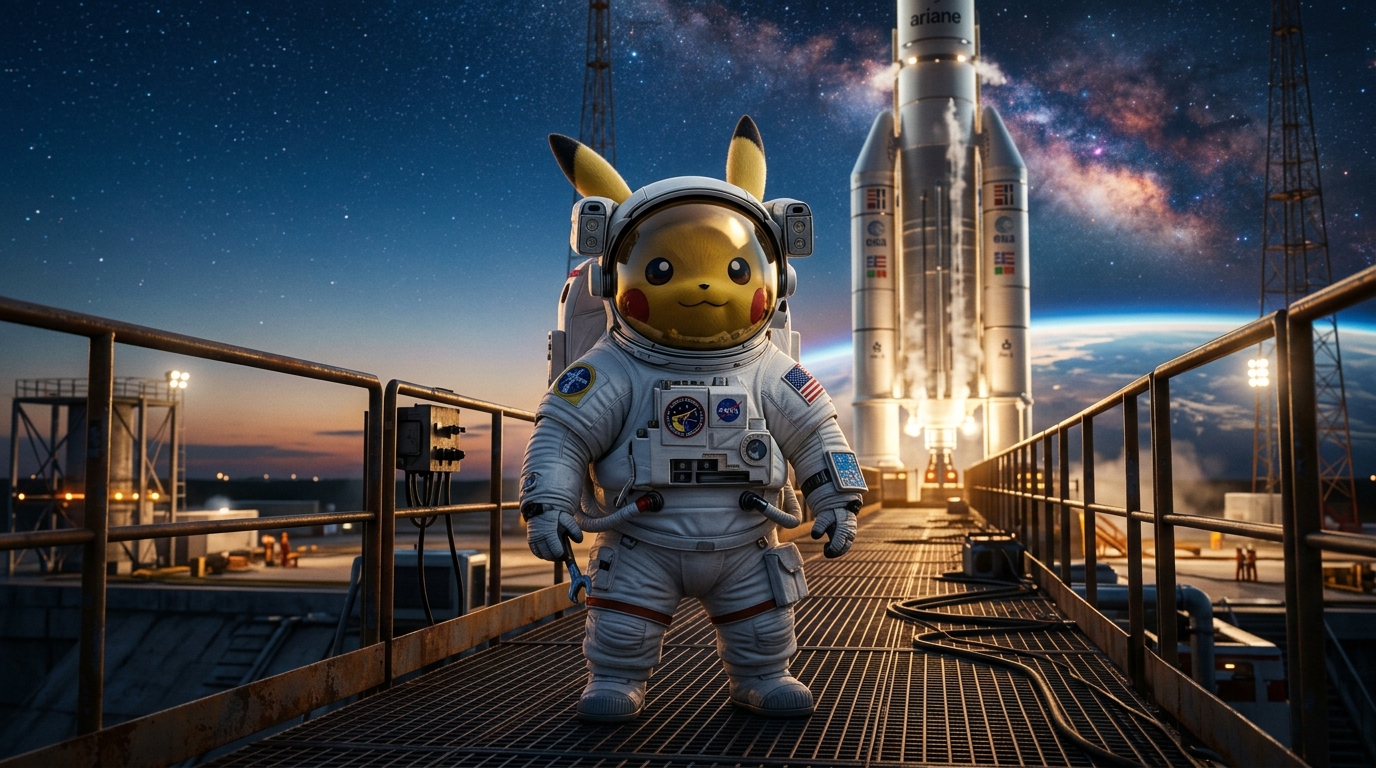
The undisputed centerpiece of the entertainment collaboration is Astronaut Pikachu. Clad in a pressurized white extravehicular mobility unit (EMU) complete with gold-visored helmet and working thruster anims, this costume variant is one of the most distinctive collectibles in the franchise.
Primary Encounter Methods
- Tier 1 Cosmic Raids: Solo-accessible 1-Star Raids will hatch globally throughout the week, featuring guaranteed capture encounters for Astronaut Pikachu.
- Timed Research Tracks: Players who complete the branching "Rocket Engineer" research line earn high-IV encounters alongside Avatar space suits.
- Geospatial Museum PokéStops: Spinning stops located within 500 meters of participating space centers guarantees event research missions.
- Shiny Hunting: Lucky players can encounter the Shiny variant of Astronaut Pikachu, which features deeper orange fur accents and an iridescent helmet visor.
PvP Battle Viability & Move Pool
Unlike purely decorative cosmetic forms, Astronaut Pikachu brings tactical value to competitive Great League formats. Upon capture, it possesses the Fast Attack Spark and has access to the exclusive steel-type Charged Attack Meteor Mash via Elite Charged TM.
This dual Electric/Steel offensive profile provides neutral or super-effective coverage against prominent Flying and Fairy-type meta staples such as Azumarill, Mandibuzz, and Altaria. Trainers looking to optimize PvP performance should target an IV distribution of 1/15/14 for optimal stat product optimization.
06 Museum Exhibits & Space Science Education: Bridging the STEM Gap
Beyond entertainment, the broader goal of world space week 2026 is accelerating space science education. Educational institutions face a persistent shortage of applicants in aerospace engineering, orbital robotics, and computational astrobiology.
By pairing the space week 2026 pokemon phenomenon with physical science centers, attendance at aerospace exhibits has surged. Planetariums across Europe and North America report that over 65% of visiting families cited the AR scavenger hunt as their primary motivation for attending, with the vast majority subsequently enrolling in youth astronomy clubs.
These collaborative exhibits showcase real scale models of lunar bases, ion propulsion thrusters, and orbital biological greenhouses. When children see Astronaut Pikachu standing beside a full-scale rocket stage, complex physics becomes intuitive, approachable, and thrilling.
07 Frequently Asked Questions About World Space Week 2026
What is the official theme for World Space Week 2026?
The official theme is World Space Week 2026 Rocket Revolution. It celebrates the commercialization of fully reusable heavy-lift orbital rocket vehicles, affordable access to low Earth orbit, and the proliferation of university and private microgravity research laboratories.
What is the space week 2026 pokemon crossover?
The space week 2026 pokemon collaboration is a worldwide partnership between Niantic (Pokémon GO), the European Space Agency (ESA), and international aerospace museums. It rewards players with special research tasks and encounters with Astronaut Pikachu when exploring real-world science venues.
How do you catch Astronaut Pikachu during World Space Week 2026?
Trainers can catch Astronaut Pikachu by completing limited-time Timed Research tracks, defeating 1-Star Cosmic Raids, spinning partner PokéStops at planetariums and observatories, or encountering it rarely in the wild between October 4 and October 10, 2026.
Can Astronaut Pikachu be shiny in Pokémon GO?
Yes, Niantic has confirmed that Shiny Astronaut Pikachu will be available in raids, research reward encounters, and wild spawns throughout the duration of the event with boosted shiny odds during weekend hours.
How does the Rocket Revolution impact microgravity and biogravity research?
By reducing launch costs to below $500/kg, the World Space Week 2026 Rocket Revolution allows biotech researchers to fly frequent orbital missions. This accelerates breakthroughs in 3D stem cell growth, protein crystallization, and organoid bioprinting in weightless environments.
08 Concluding Summary: The Future of Space Exploration and Public Engagement
In summary, world space week 2026 stands as a landmark turning point in human aerospace history. Through the breathtaking milestones of the World Space Week 2026 Rocket Revolution, reusable rocket systems are making low Earth orbit an everyday platform for advanced microgravity science and transformative biogravity breakthroughs.
Concurrently, the cultural excitement of the space week 2026 pokemon collaboration demonstrates that space exploration is most potent when it invites everyone to participate. Finding an Astronaut Pikachu outside an observatory dome sparks a sense of universal wonder that will inspire the next generation of engineers, flight controllers, and biomedical researchers.
As October 4–10 unfolds across the globe, we invite you to look upward, join your local science community, and celebrate the magnificent rocket revolution that is carrying humanity outward into the cosmos.
Dr. Shaiob directs research programs in microgravity biophysics, cellular stress response, and orbital molecular biology. Committed to public science communication and open-access STEM education.